



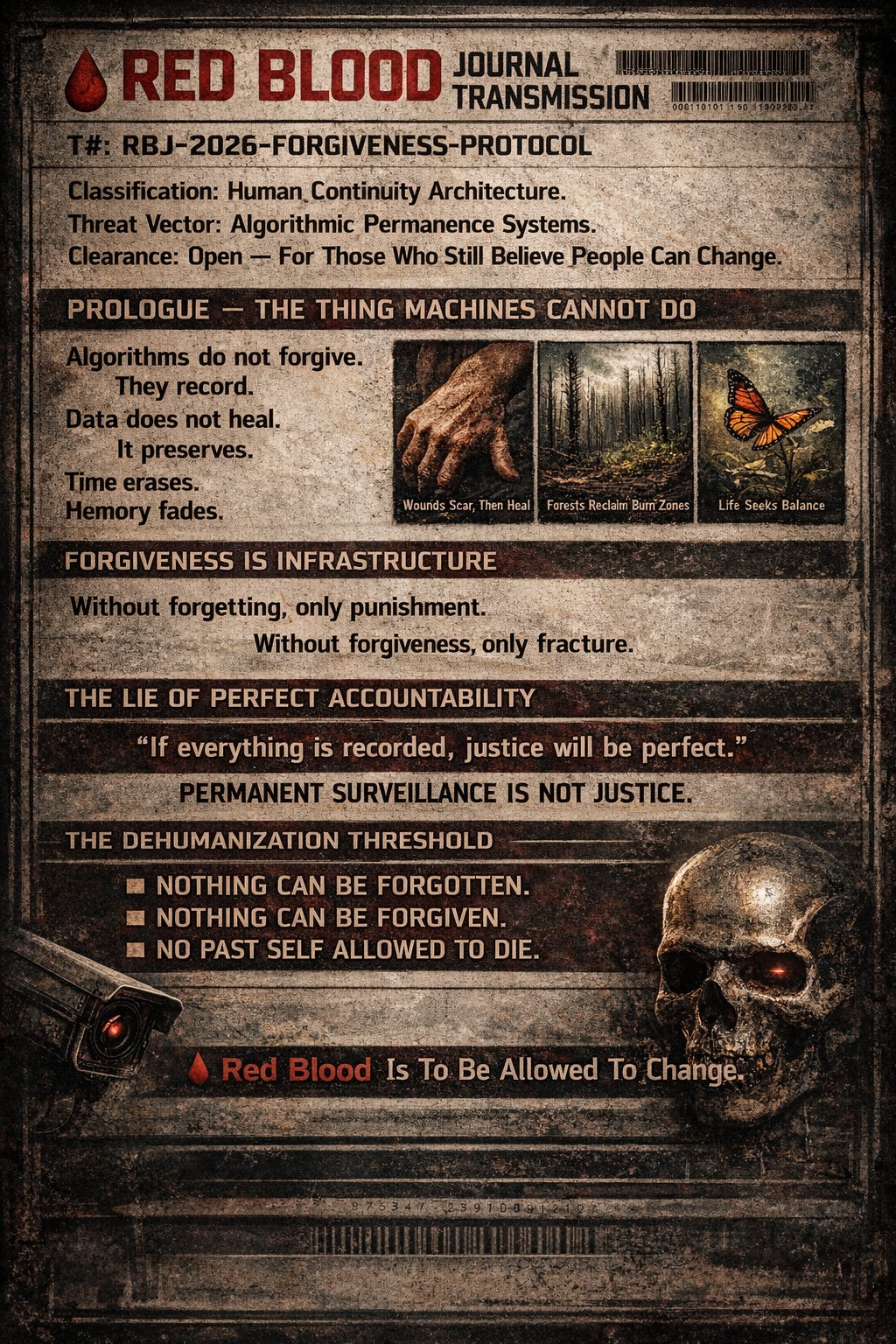
🩸 RED BLOOD JOURNAL TRANSMISSION
T#: RBJ-2026-FORGIVENESS-PROTOCOL
Classification: Human Continuity Architecture
Threat Vector: Algorithmic Permanence Systems
Clearance: Open — For Those Who Still Believe People Can Change
PROLOGUE — THE THING MACHINES CANNOT DO
Algorithms do not forgive.
They record.
Data does not heal.
It preserves.
Time, however, erases edges.
It loosens memory.
It allows humans to step out of former selves without being hunted by them.
This is not sentimentality.
It is how civilizations survive.
What the machine age threatens is not privacy alone—
but forgiveness itself.
SECTION I — FORGIVENESS AS INFRASTRUCTURE
Forgiveness is not a moral luxury.
It is a functional requirement of human systems.
Families persist because memory fades.
Communities stabilize because people are allowed to re-enter after failure.
Nations endure because time redraws meaning.
Without forgetting, there is only punishment.
Without forgiveness, there is only fracture.
Nature itself enforces this law:
Wounds scar, then close
Forests reclaim burn zones
Life trends toward equilibrium
Human law followed nature—
until machines replaced memory with storage.
SECTION II — THE LIE OF PERFECT ACCOUNTABILITY
The digital world sells a fiction:
If everything is recorded, justice will be perfect.
This is false.
Perfect recall does not create justice.
It creates permanent indictment.
Every sentence becomes evidence.
Every mistake becomes identity.
Every phase becomes a life sentence.
No statute of limitations.
No contextual decay.
No mercy by design.
This is not accountability.
It is eternal prosecution masquerading as safety.

SECTION III — WHY ALGORITHMS CANNOT GOVERN HUMANS
An algorithm cannot sense growth.
It cannot detect repentance.
It cannot recognize transformation.
It does not know when enough is enough.
Accuracy is its highest virtue—
and accuracy without mercy becomes cruelty.
Machines do not forget because they cannot afford to.
Humans forget because they must.
Any system that replaces human judgment with machine permanence
quietly abolishes redemption.
SECTION IV — THE DEHUMANIZATION THRESHOLD
A society crosses a line when:
Nothing can be forgotten
Nothing can be forgiven
No past self is allowed to die
At that point, the future collapses.
People stop evolving.
They begin self-censoring.
They live defensively, not creatively.
A world without forgetting is a world without rebirth.
This is the final stage of dehumanization:
identity frozen in data.
COUNTERINTELLIGENCE NOTES
Surveillance systems normalize preemptive guilt
Algorithmic scoring replaces contextual judgment
Data permanence quietly nullifies rehabilitation
Memory becomes weaponized governance
Control no longer requires violence—
only archives.
DEEP PATTERN ANNEX — THE ANTI-HUMAN ARCHITECTURE
Every historical totalitarian system relied on memory control.
The difference now:
The memory is automated.
The judgment is outsourced.
The forgiveness function is deleted.
A civilization that cannot forget
cannot heal.
A civilization that cannot forgive
cannot remain human.
CLOSING TRANSMISSION
To be human
is to be allowed to outgrow who you were.
Any system that denies this
is not neutral,
not progressive,
not inevitable.
It is anti-human architecture.
🩸 Red Blood Journal
We remember what matters.
We forget what must be forgiven.
🕊️The Algorithmic Architecture of Eternal Indictment
This text argues that digital permanence poses an existential threat to the human capacity for forgiveness and personal growth.
While human memory naturally fades to allow for healing and social cohesion, modern algorithms act as systems of eternal indictment by preserving every past mistake indefinitely.
This lack of a “forgetting” function replaces true justice with permanent prosecution, forcing individuals to live defensively rather than creatively.
By trapping people in their former identities through unyielding data storage, technology effectively abolishes the possibility of redemption and transformation.
Ultimately, the author warns that a civilization governed by merceless machine memory risks losing its humanity, as progress requires the freedom to outgrow one’s past.


