


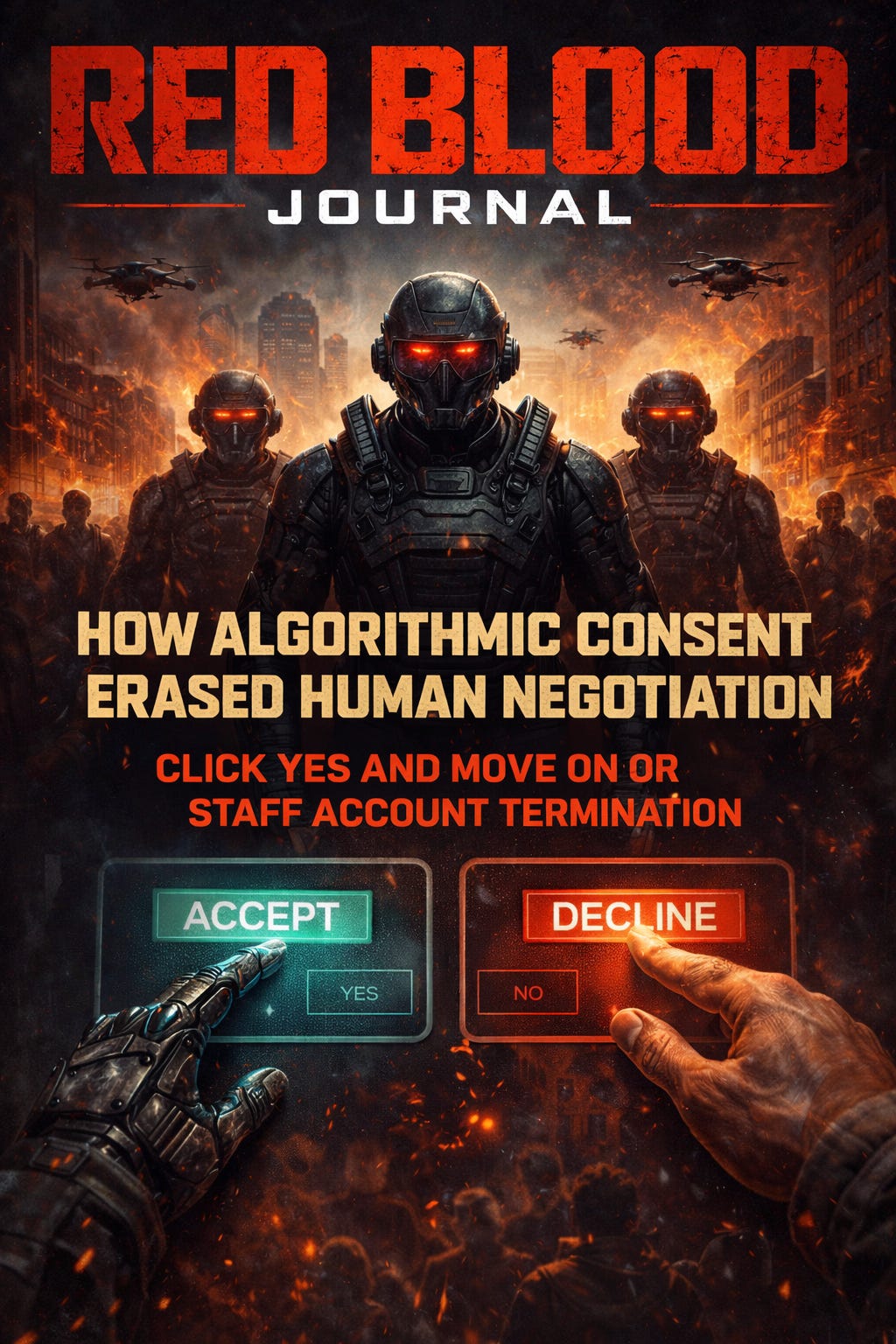
🩸 🔘RED BLOOD JOURNAL — NEXT SIGNAL
Transmission ID: RBJ-SIG-ALG-CONSENT-01
Classification: Behavioral Automation | Consent Compression | Social Protocol Collapse
Clearance: For Those Who Still Remember How to Negotiate
HOW ALGORITHMIC CONSENT ERASED HUMAN NEGOTIATION
PROLOGUE — THE BUTTON
Once, consent was a conversation.
Now it’s a button.
Accept. Decline. Skip. Block. Mute.
One tap replaces a thousand years of ritual—tone, timing, insistence, retreat, return.
Negotiation didn’t vanish.
It was compressed.
SECTION I — FROM RITUAL TO RULESET
Human societies evolved ritual friction on purpose:
Offers repeated to prove sincerity
Refusals softened to preserve dignity
Insistence calibrated to show care
Yielding delayed to test intention
Algorithms removed friction because friction slows throughput.
What replaced it:
Binary responses
Zero context
Permanent outcomes
No repair phase
In code, “no” must be final—because systems can’t interpret warmth.
SECTION II — CONSENT AS COMPLIANCE
Algorithmic consent didn’t protect autonomy.
It redefined it.
When every interaction is reduced to:
Do you agree? Yes / No
…the system learns preferences, not meanings.
It optimizes for:
Risk reduction
Liability avoidance
Predictable behavior
Minimum emotional bandwidth
What it cannot model:
Polite refusal
Ritual insistence
Negotiated acceptance
Social courage
So it deletes them.
SECTION III — THE DEATH OF THE MIDDLE SPACE
Human negotiation lives in the middle space:
Between offer and acceptance
Between refusal and insistence
Between boundaries and bonds
Algorithms hate the middle space.
It’s ambiguous.
It’s inefficient.
It can’t be logged cleanly.
So the middle is erased.
What remains:
Silence
Escalation
Cancellation
Isolation
A world where every refusal ends the relationship.
SECTION IV — WHY THIS BENEFITS THE SYSTEM
A population that cannot negotiate:
Cannot persuade
Cannot reconcile
Cannot repair
Cannot build trust across difference
They can only comply or exit.
This creates:
Hyper-individualism
Social fragility
Endless offense cycles
Dependence on platforms to mediate humanity
When people stop negotiating with each other, they negotiate through systems.
And systems always win.
SECTION V — THE OLD WORLD KNEW BETTER
Ancient hospitality understood something algorithms cannot:
A first “no” is often politeness.
A second offer is sincerity.
A third exchange is trust.
Negotiation was not coercion.
It was proof of presence.
COUNTERINTELLIGENCE NOTES
Algorithmic consent trains people to fear persistence
Insistence is reframed as aggression
Social courage is pathologized
Warmth is flagged as risk
This is not accidental.
It is design.
EPILOGUE — WHAT WAS TAKEN
They didn’t just automate consent.
They erased:
Human back-and-forth
Moral courage
Spiritual patience
The right to change one’s mind mid-conversation
They replaced it with a world where:
If you didn’t click yes, you’re gone.
🩸 Signal Complete
Next Transmission (Queued):
“Insistence Is Not Violence: How Systems Taught Humans to Fear Each Other”
🔘The Algorithmic Erasure of Human Negotiation
The provided text explores how modern technology has replaced the nuanced, historical rituals of human interaction with binary digital commands.
By forcing users into simple “accept” or “decline” choices, algorithms eliminate the “middle space” where social bonds and mutual trust were traditionally built through back-and-forth communication.
This shift prioritizes systemic efficiency and liability reduction over the complex emotional labor required for genuine negotiation and reconciliation.
Consequently, the source argues that society is becoming socially fragile because people are losing the ability to navigate disagreement or persistence without resorting to total isolation.
Modern algorithms replace nuanced human negotiation with binary choices, erasing the “middle space” of social ritual.
By prioritizing efficiency and compliance, systems destroy social trust and reconciliation, leaving users to either comply or exit without any empathy.
Ultimately, this automated consent transforms human relationships into rigid transactions that benefit platforms rather than preserving interpersonal connection.


