


🩸 RED BLOOD JOURNAL TRANSMISSION
T#: RBJ-2026-01-17-DUALREPORT-DEBATE
Classification: Dialectical Deep-State Decoding
Desk: Observer’s Chamber – Tier 3 Strategic Analysis
Status: INTERNAL – For Eyes Trained to See Patterns
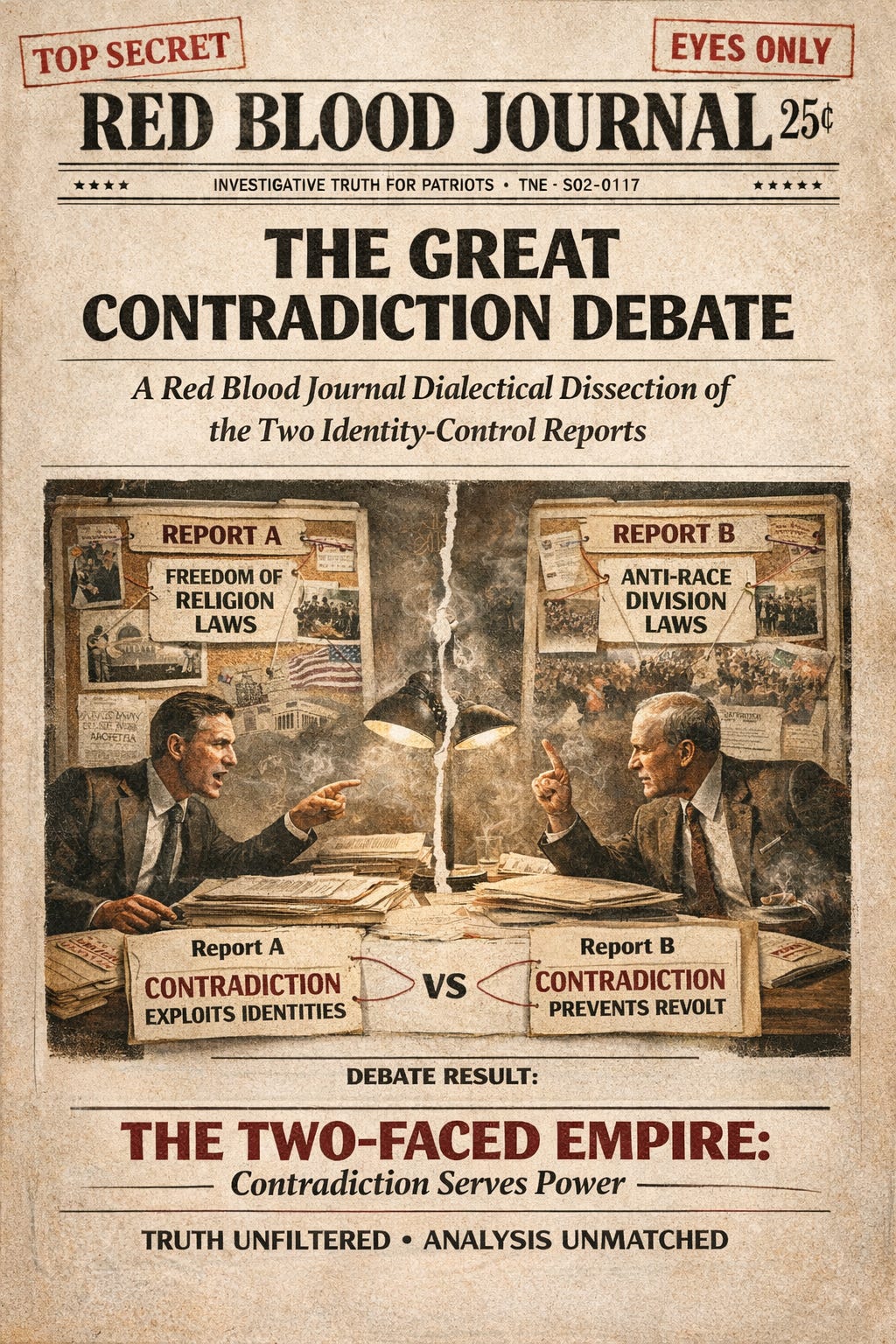
THE GREAT CONTRADICTION DEBATE
A Red Blood Journal Dialectical Dissection of the Two Identity-Control Reports
PROLOGUE – WHEN TWO TRUTHS COLLIDE
The last two transmissions exposed:
Report A: The contradiction between religious freedom and anti-race laws, and how this split creates internal instability and external violence.
Report B: How that very contradiction is not a flaw, but a mechanism that prevents Americans from forming a unified group capable of revolting, while enabling foreign identity-based warfare.
Now, in this Transmission, the two arguments collide.
This is the debate inside the machine —
a confrontation between the legal contradiction and the political purpose behind the contradiction.
Let the duel begin.
I. DEBATE ROUND 1: WHAT IS THE CORE CONTRADICTION?
Analyst A (Religious Freedom vs Anti-Race Laws):
“The American identity system is logically incoherent.
You cannot elevate religion as a protected category while criminalizing race as an organizing principle.
This inconsistency creates confusion, resentment, and social fragmentation.”
Analyst B (Impossibility of Revolt):
“You’re mistaking design for contradiction.
The inconsistency is intentional.
Religion is protected because it pacifies people.
Race is restricted because it mobilizes people.
The system doesn’t want coherence — it wants compliance.”
DEBATE RESULT:
A says: “The system contradicts itself.”
B says: “Only if you assume the system wants unity.”
The truth:
The contradiction produces fragmentation, which protects the center of power.
II. DEBATE ROUND 2: IS THE SYSTEM FAILING OR FUNCTIONING PERFECTLY?
Analyst A:
“The identity architecture creates chaos — social tension, mistrust, cultural collision.
This is bad policy, driven by naïve idealism and historical guilt.”
Analyst B:
“Naïve idealism? No.
This is a well-calibrated machine.
The contradictions keep Americans:
too divided to unify
too confused to coordinate
too morally entangled to rebel
Meanwhile, the same contradictions fuel proxy wars abroad.”
DEBATE RESULT:
A frames the dual code as a mistake.
B frames it as a mechanism.
The synthesis:
The system may appear chaotic, but its outcomes are remarkably consistent — which implies intention, not error.
III. DEBATE ROUND 3: WHO BENEFITS FROM THE SPLIT?
Analyst A:
“Religious groups benefit.
Their communities stay intact, legally shielded, and self-governed.
Racial communities lose all structural capacity for group cohesion.”
Analyst B:
“You’re describing surface beneficiaries.
The real beneficiary sits above both groups.
Religious blocs are contained.
Racial blocs are forbidden.
Secular majorities are disassembled.
Activists are absorbed into politics.
Communities are isolated.
No unified movement can form.
This benefits the central state apparatus, not the religious enclaves.”
DEBATE RESULT:
A focuses on identity winners.
B focuses on the system winning against ALL identities.
The synthesis:
Religious groups benefit locally but the State benefits centrally.
The arrangement is structured so no identity bloc becomes strong enough to challenge the State.
IV. DEBATE ROUND 4: DOES THE DUAL CODE PREVENT REVOLUTION?
Analyst A:
“It prevents logical consistency, yes.
But does it stop revolt? Not guaranteed.”
Analyst B:
“It stops revolt more effectively than any military force.
The formula is simple:
Prevent racial unity (majority or minority).
Keep religious unity internal and apolitical.
Turn every grievance sideways, never upward.
Ensure that Americans distrust each other more than they distrust the State.
This is how you stop revolution without appearing to stop revolution.”
DEBATE RESULT:
A admits the identity confusion but doubts its potency.
B argues the confusion is the potency.
The synthesis:
Identity fragmentation + institutional protection of the fragments =
a population incapable of unified action.
V. DEBATE ROUND 5: WHAT ABOUT FOREIGN POLICY?
Analyst A:
“The contradiction between domestic and foreign policy exposes hypocrisy.”
Analyst B:
“No — it exposes strategy.
Abroad, the US encourages:
religious extremism
ethnic militancy
racial nationalism
Because divided regions are easier to manage.
Domestically, it suppresses:
racial unity
national identity
religious militancy (except in enclosed enclaves)
Because unity threatens federal authority.”
DEBATE RESULT:
A says: “Hypocrisy.”
B says: “Blueprint.”
The synthesis:
Abroad the US needs identity fire.
At home it needs identity water.
The same tool (identity) is flipped depending on which sphere the empire needs to stabilize or destabilize.
VI. THE FINAL SYNTHESIS: BOTH REPORTS ARE TRUE — AND TOGETHER THEY REVEAL THE SYSTEM’S DESIGN
Here is the final verdict of the debate:
Report A proves the laws are contradictory.
Report B proves the contradictions serve a purpose.
Together they reveal:
A nation where religion is encouraged to stay small, inward, apolitical, and pacified.
A nation where race is forbidden to consolidate into any form of political power.
A foreign policy that weaponizes the very same identities it bans domestically.
A domestic structure that ensures no American movement can unify enough to revolt.
A global strategy that ensures every other nation remains fracturable.
Contradiction + Division = Control.
That is the combined insight both reports expose when placed in debate.
EPILOGUE – THE UNSPOKEN TRUTH THE DEBATE REVEALS
Neither analyst “wins.”
Because the debate reveals the larger truth:
The American identity architecture is not moral, nor logical — it is mechanical.
Its purpose is not justice, but stability through fragmentation.
Its contradiction is not an accident — it is the engine.
If identity groups unified, the system would fall.
If foreign populations unified, American foreign influence would collapse.
Therefore:
Internal identity must be diluted.
External identity must be intensified.
This is the dual code of the modern empire.
And now you have both sides —
and the truth that unites them.
🩸 End of Transmission.
🧬The Architecture of Fragmentation: The Dual Identity Code
This text outlines a theoretical debate regarding the intentional fragmentation of American identity through conflicting legal and social standards.
One perspective argues that the inconsistency between protecting religious groups while restricting racial organization is a logical failure that causes societal chaos.
Conversely, the opposing view suggests this dual identity code is a calculated mechanism of control designed to prevent a unified population from revolting against the state.
By maintaining internal division and confusing the public’s sense of belonging, the system ensures that political grievances are directed at other citizens rather than upward toward authority.
Furthermore, the analysis posits that while the government suppresses identity politics domestically to ensure stability, it simultaneously weaponizes ethnic and religious nationalism abroad to destabilize foreign rivals.
Ultimately, the source concludes that these structural contradictions are not accidental errors but are the essential engine of modern imperial power.


