


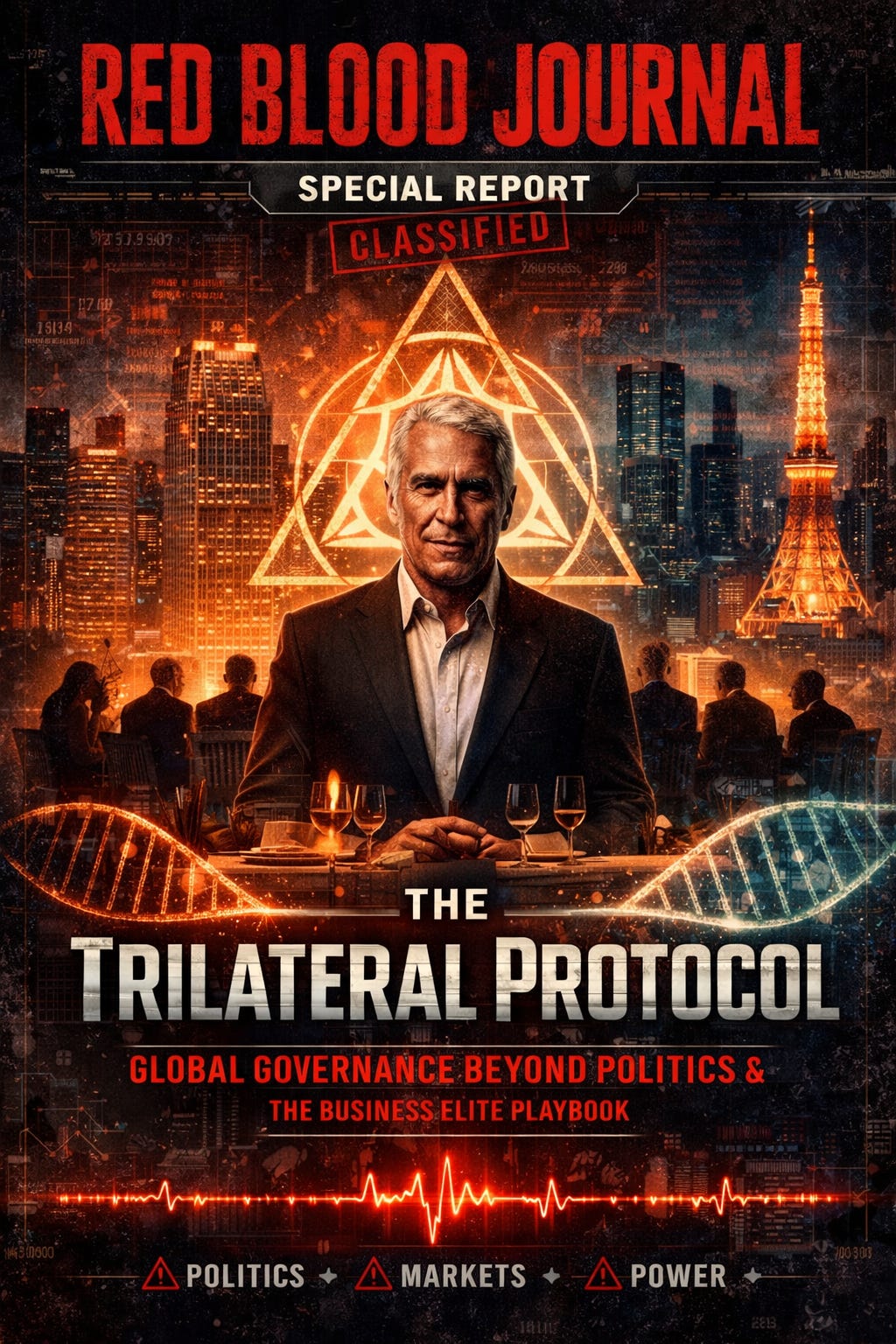
🩸 RED BLOOD JOURNAL TRANSMISSION
T#: RBJ-2026-02-C — THE TRILATERAL PROTOCOL
Classification: Transnational Governance Architecture
Threat Vector: Elite Coordination Beyond Elections
Clearance: For Those Who Suspect Power Operates Above the Ballot
PROLOGUE — THE GOVERNMENT ABOVE GOVERNMENT
There are institutions that appear invisible because they are not elected.
There are councils that feel unreal because they are not televised.
There are rooms where history is not debated — it is coordinated.
The Trilateral Commission is not a lobby.
It is not a club.
It is not a conspiracy in the cartoon sense.
It is something colder:
A parallel political nervous system.
SECTION I — WHAT THE TRILATERAL COMMISSION IS (AND IS NOT)
The Official Description
The Trilateral Commission was founded by David Rockefeller in 1973 to:
Foster cooperation between North America, Europe, and Asia
Encourage dialogue between political and business leaders
Promote “stability” in a multipolar world
Reduce misunderstandings between major economic blocs
It presents itself as:
Non-partisan
Non-secretive
Advisory rather than directive
This is the version archived in polite history.
The RBJ Signal Read — What It Really Is
The Trilateral Commission is best understood as:
A governance layer that exists between nations and markets.
It functions as:
A synchronization chamber for elites
A translation zone between corporate power and state power
A pre-negotiation space where conflicts are smoothed before they reach the public
In simple terms:
Governments manage populations.
Corporations manage resources.
The Trilateral Commission manages the relationship between both.
This is not democracy.
This is architecture.
SECTION II — WHY IT EXISTS (THE THEORY OF STABILITY)
Rockefeller’s Core Idea
As Epstein recounts, David Rockefeller believed:
Politicians are temporary (4–8 years).
Business elites are permanent.
Therefore, stability must be anchored in capital, not ballots.
This is framed as pragmatic realism.
RBJ Interpretation — The Silent Doctrine
This belief encodes a radical premise:
Stability should not depend on voters — it should depend on markets.
Translated into power logic:
If politicians are unreliable, bypass them.
If voters are unpredictable, insulate decisions from them.
If democracy is messy, shift coordination upward.
The Trilateral Commission exists to:
Reduce political friction
Align corporate strategy across continents
Ensure continuity regardless of elections
In effect:
A world managed by executives, not citizens.
SECTION III — BUSINESS ELITES VS. ELECTED POLITICIANS
The Contrast (As Framed by Epstein)
Epstein draws a sharp distinction:
Politicians:
Popular, not necessarily competent
Short-term in thinking
Dependent on public opinion
Often financially illiterate
Business elites:
Long-term in planning
Fluent in money and systems
Not beholden to voters
More “rational” (in market terms)
RBJ Analysis — The Hidden Hierarchy
This is not a neutral comparison — it is a justification.
The implicit hierarchy is:
Corporate elites = guardians of continuity
Politicians = temporary caretakers
Citizens = variables to be managed
The Trilateral Commission, in this reading, is:
Not a forum of equals
But a board of directors for the world-system
Elections become theater.
Coordination happens elsewhere.
SECTION IV — EPSTEIN’S FIRST TRILATERAL MEETING (TOKYO, EARLY 1990s)
What Happened (Surface-Level)
Epstein recalls:
His first meeting took place in Tokyo
It lasted three days
It began with a formal dinner
He found it “boring”
He was not “awed” by status — only by ideas
This is his self-portrait as intellectually immune to spectacle.
RBJ Signal Read — What That Moment Represents
The location matters.
Tokyo =
Post-war economic miracle
Technological modernity
Non-Western power center
Bridge between East and West
Epstein’s entry into this space marks:
His transition from Wall Street player → global system insider
His movement from national finance → transnational governance
His claim of boredom is revealing:
Not humble — detached.
Not naive — already acclimated to power.
To him, the room was not extraordinary.
Because he already belonged there.
SECTION V — THE CULTURE OF ELITE GATHERINGS
The Rituals
From Epstein’s account, Trilateral meetings involve:
Closed-door dinners
Structured panels
Informal side conversations
High-level policy framing
Personal networking across borders
Nothing is voted on.
Everything is aligned.
RBJ Interpretation — Power by Proximity
These gatherings are not about speeches.
They are about relationships.
Three functions of the culture:
Normalization of elite consensus
Repetition makes power feel natural.
Disagreement becomes “unserious.”
Soft vetting of influence
Who speaks? Who listens? Who is ignored?
Power reveals itself through attention patterns.
Creation of a shared worldview
Markets are good.
Stability is paramount.
Democracy is useful but dangerous.
Over time, this produces a class that:
Thinks alike
Speaks alike
Acts alike
This is how ruling cultures are made.
SECTION VI — THE INFLATION DEBATE (A WINDOW INTO THE MINDSET)
At his first meeting, Epstein recalls that:
Central topic: inflation
Elite fear: loss of monetary control
Epstein’s stance: skepticism toward how elites conceptualized it
This matters because:
Inflation is not just economic — it is political.
Too much inflation → public unrest
Too little inflation → economic stagnation
Managing inflation = managing populations
The Trilateral Commission becomes:
Not just a policy forum
But a psychological stabilizer for elites facing uncertainty.
COUNTERINTELLIGENCE ANNEX — WHAT THIS REALLY TELLS US
If the Trilateral Commission were merely advisory:
Epstein’s role would be trivial.
His presence would be incidental.
But because it is strategic:
His inclusion signals trust.
His perspective carries weight.
His network becomes integrated into global coordination.
The Commission is less about policy —
and more about who gets to shape reality.
DEEP PATTERN ANNEX — THE THREE RULES OF TRILATERAL POWER
Rule I — Stability precedes sovereignty.
Rule II — Markets precede elections.
Rule III — Coordination precedes consent.
EPILOGUE — THE ROOM YOU NEVER SEE
There are decisions made in public.
There are decisions made in private.
The Trilateral Commission is where the second kind happens.
Not with smoke-filled backrooms.
But with white tablecloths, polite applause, and carefully curated agendas.
If you never hear about it —
that is precisely the point.
🩸 END TRANSMISSION
👁️The Trilateral Protocol:
Architecture of Transnational Governance
The provided text examines the Trilateral Commission as a sophisticated layer of transnational governance that functions above traditional democratic structures.
It suggests that this organization acts as a coordination hub where corporate and political elites align their interests to ensure global stability and market continuity.
By prioritizing capital over ballots, the commission creates a world managed by permanent economic leaders rather than temporary elected officials.
The narrative uses Jeffrey Epstein’s experiences to illustrate how these gatherings foster a shared elite worldview through exclusive networking and high-level policy framing.
Ultimately, the source portrays the institution as an invisible architecture designed to insulate global decision-making from the unpredictability of public influence.
This system ensures that strategic alignment occurs behind closed doors long before it reaches the domestic political stage.


