


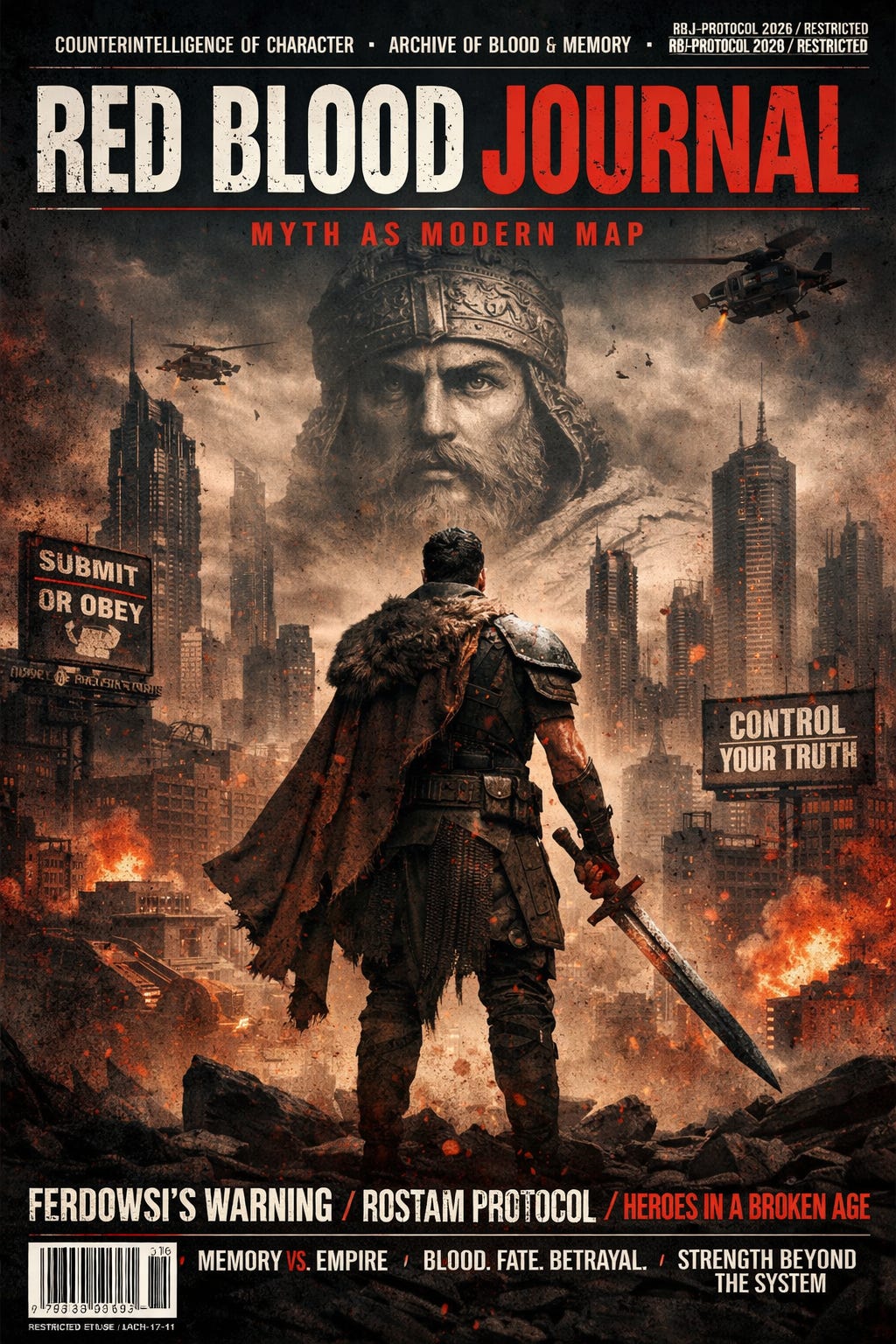
🩸 RED BLOOD JOURNAL TRANSMISSION — HYBRID FORMAT EDITION
T#: RBJ-2026-ROSTAM-PROTOCOL
Classification: Counterintelligence of Character / Myth as Modern Map
Desk: The Archive of Blood & Memory — San Diego / Tehran / In-Between
[I] PROLOGUE — A POEM AGAINST OBLIVION
Rostam did not arrive alone.
He arrived through a man who understood that empires erase memory before they erase people.
That man was Ferdowsi of Tus.
Before Rostam became a sword, he was a sentence.
Before he became a hero, he was an act of preservation.
The Shahnameh is not merely a national epic. It is a counterintelligence archive written in verse — a civilization refusing to disappear quietly.
[II] ORIGIN OF THE ARCHIVE — WHO FERDOWSI WAS
Ferdowsi (Abul-Qasim Ferdowsi Tusi) was not a court propagandist. He was a provincial intellectual, rooted in the old Iranian cultural memory at a moment when it was being overwritten.
He lived in a world where:
Persian political sovereignty had collapsed.
Arabic had become the language of power, administration, and prestige.
Pre-Islamic Iranian history was being dismissed as pagan, irrelevant, or dangerous.
Ferdowsi chose a different path.
Over decades, he gathered scattered oral traditions, earlier written chronicles (notably the work of Daqiqi), and fragments of ancient Iranian memory, and forged them into a single monumental work — the Shahnameh: The Book of Kings.
This was not nostalgia. It was resistance.
In an age of cultural amnesia, Ferdowsi rebuilt a nation in language.
[III] HOW IT ALL STARTED — THE POLITICAL ENGINE BEHIND THE EPIC
The Shahnameh did not emerge in a vacuum.
It was completed in the early 11th century under the Ghaznavid dynasty, specifically during the reign of Sultan Mahmud of Ghazni.
The irony is precise:
Mahmud sought glory, conquest, and legitimization through Persian culture.
Ferdowsi sought the survival of Persian identity itself.
The story goes that Ferdowsi was promised gold for each couplet. The promise was broken. The poet, insulted and unpaid, rejected the patronage of raw imperial power.
The poem survived anyway.
This fracture is crucial:
From its first breath, the Shahnameh is a work written beside power, not beneath it.
Rostam is born inside this political tension.
[IV] ROSTAM’S BIRTH — THE COST OF EXCEPTIONAL LIFE
Rostam enters the world through crisis.
Rudābeh’s body cannot deliver him. The Simurgh intervenes. A surgical cut saves both mother and child — a mythic precursor to modern medicine.
Modern resonance:
Civilizations celebrate heroes while forgetting the violent conditions that produced them. Systems extract greatness from people and then sanitize its origins into legend.
Ferdowsi embeds this truth at Rostam’s very birth.
[V] THE SEVEN LABORS — A MAP OF POWER
Rostam’s Seven Labors are not random trials. They are an architecture of consciousness:
The Lion — brute force and visible danger
The Desert of Thirst — scarcity as control
The Dragon — hidden predatory systems
The Witch — seduction masquerading as salvation
The Demon — institutional cruelty
Illusion — propaganda and cognitive warfare
The White Demon — centralized tyranny
Ferdowsi encodes political philosophy as myth.
Today’s translation:
Modern life reproduces the same corridor — engineered scarcity, spectacle, manipulation, and invisible coercion — but calls it “normal.”
Rostam survives because he recognizes patterns.
[VI] SOHRAB — THE GENERATIONAL WOUND
Rostam unknowingly kills his own son.
This is not merely a family tragedy; it is a systemic one.
Sohrab is the future — powerful, idealistic, external to the center of power.
Rostam is the loyal enforcer of an aging order.
They fight because recognition has been prevented.
Only after the fatal wound does the truth emerge.
Contemporary mirror:
Systems manufacture conflict between generations while hiding their shared interests. Youth are framed as reckless; elders as obsolete. Both bleed while elites remain untouched.
Sohrab’s death is the signature of every empire that eats its own children.
[VII] ESFANDIYĀR — THE COLLISION OF LAW AND LIFE
Esfandiyār is divinely protected and politically authorized.
The king orders Rostam to submit in chains.
Rostam refuses.
The conflict is not personal — it is structural:
sovereign individual versus sanctified institution.
Rostam prevails through the Simurgh’s ancient knowledge — intelligence older than the state.
Modern lesson:
Authority dresses itself in legality, morality, and sacred narrative. Those who resist are labeled enemies of order.
A society that forces its greatest defender to kill its most blessed champion is already internally fractured.
[VIII] ROSTAM AND THE KINGS — POWER WITHOUT A CROWN
Again and again, Rostam saves reckless kings from their own stupidity.
He is stronger than them.
He is wiser than them.
Yet he remains subordinate.
This is the paradox Ferdowsi records with surgical precision:
Those who truly sustain a civilization rarely rule it.
Today’s structure:
Workers, engineers, soldiers, and caretakers hold the world together, while symbolic leaders harvest credit and evade accountability.
Rostam is the hidden infrastructure beneath the spectacle of sovereignty.
[IX] THE PIT — THE LOGIC OF COLLAPSE
Rostam does not fall in glorious battle.
He is betrayed by his own kin, trapped in a pit, and stabbed from above.
The enemy is internal.
Civilizational lesson:
No empire collapses primarily from outside force. Collapse arrives through corruption, betrayal, and erosion of trust within.
The pit is the institution that once protected life and later becomes its trap.
[X] DEEP PATTERN ANNEX — WHAT FERDOWSI BUILT THROUGH ROSTAM
Ferdowsi did more than tell stories. He built a moral diagnostic for future generations:
Memory is a form of sovereignty.
Language is a battlefield.
Heroes reveal the health of a society.
Power fears independent strength.
Betrayal precedes conquest.
Truth often survives without official sponsorship.
[XI] COUNTERINTELLIGENCE NOTES — ROSTAM AS A PRESENT-DAY MAP
If Rostam walked today:
He would distrust spectacle.
He would refuse digital chains.
He would listen to older forms of knowledge.
He would see through moral theater disguised as patriotism.
Ferdowsi did not preserve Rostam so he could be admired. He preserved him so he could be recognized — and perhaps reactivated.
[XII] EPILOGUE — THE SIGNAL THAT OUTLIVED EMPIRES
Empires rise and fall.
The Shahnameh remains.
Rostam endures not because he was powerful, but because Ferdowsi understood that stories are the deepest defense a people can have.
The question hanging over the present is unforgiving:
Is this an age that would recognize a Rostam — or an age engineered to destroy one?
🦁The Rostam Protocol:
Myth as Civilizational Resistance
The provided text explores the Shahnameh and its legendary hero, Rostam, as a vital mechanism for civilizational preservation and political resistance.
It argues that the poet Ferdowsi utilized these myths to safeguard Persian identity against cultural erasure, transforming ancient stories into a moral diagnostic for future generations.
By analyzing Rostam’s life—from his surgical birth to his tragic betrayal—the author frames these narratives as timeless maps for navigating systemic corruption and power dynamics.
The text suggests that the epic serves as a counterintelligence archive, teaching individuals to recognize patterns of tyranny and institutional manipulation.
Ultimately, it emphasizes that language and memory are the primary defenses against the collapse of a society’s soul.


