


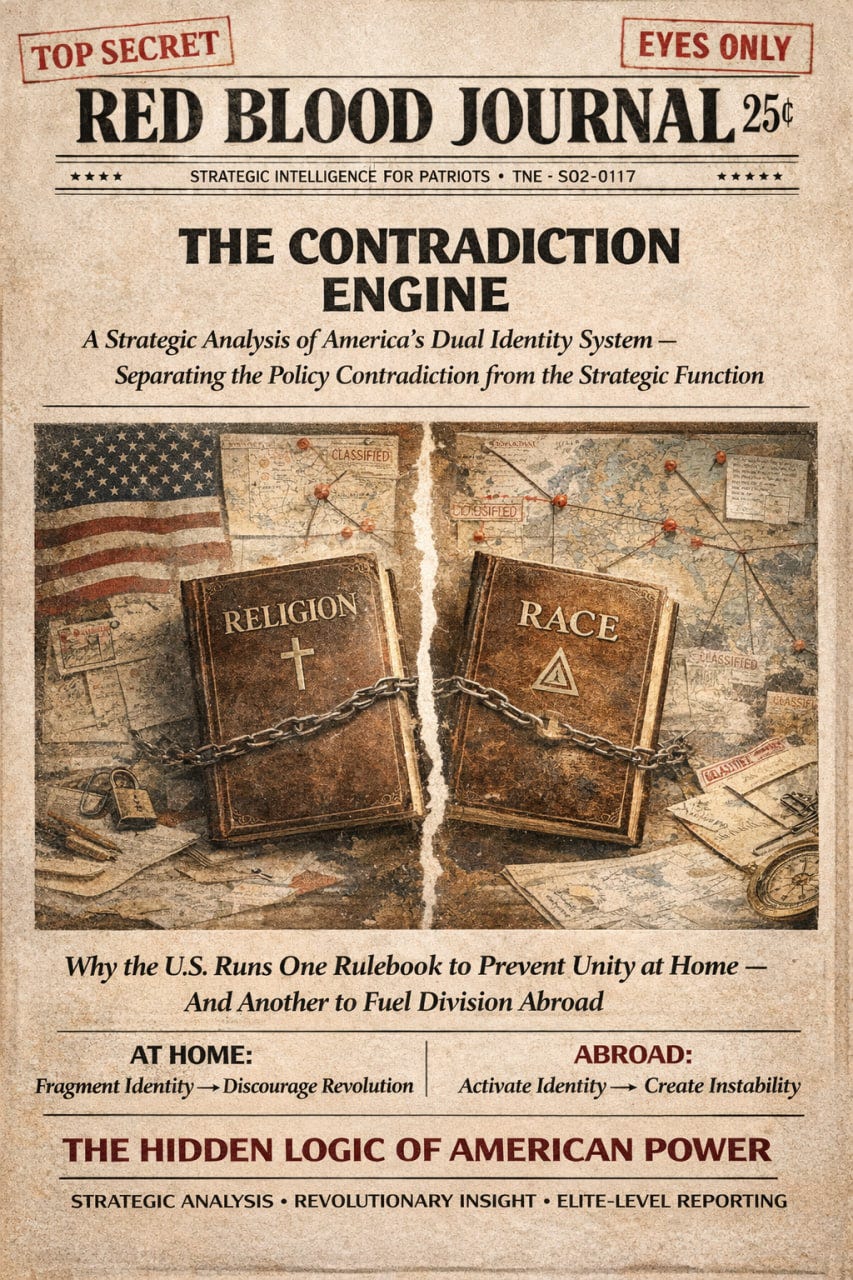
🩸 RED BLOOD JOURNAL TRANSMISSION
T#: RBJ-2026-01-17-RELIGIOUS-FREEDOM-SPLIT
Classification: Critical Systems Analysis – Law, Identity & Social Fragmentation
Desk: Civilization Frameworks & Hidden Architecture Unit
Status: UNREDACTED – For Public Reflection
**When “Religious Freedom” Becomes a Scalpel:
How It Can Generate Division, and Why Some See It as Anti-White & Pro-Religion**
EXECUTIVE SUMMARY
On paper, religious freedom is sold as a universal shield:
“No one can be punished for their beliefs; the state stays neutral; everyone wins.”
In practice, critics argue it can act like a precision knife:
Carving special legal lanes for certain groups
Deepening tribal identities instead of dissolving them
Creating the perception—especially among secular or culturally “default white” Americans—that the law is:
Soft on religion, hard on irreligion.
Protective of minority faith enclaves, but suspicious of explicitly white or secular solidarity.
This report does not say those perceptions are correct; it maps how and why they arise, and what harm and division they can generate.
I. RELIGIOUS FREEDOM: THE IDEAL VS. THE OPERATING SYSTEM
1. The Official Ideal
In the textbook version:
Government cannot establish an official religion.
Government cannot prohibit the free exercise of religion.
All faiths—and non-faith—are equal before the law.
Under that story, religious freedom is a peace treaty between the state and the soul.
2. The Real Operating System
In reality, religious freedom is implemented through:
Exemptions (you don’t have to follow X law if it burdens your faith)
Accommodations (special rules so you can practice your faith)
Heightened protections (strict scrutiny when the state interferes with religious exercise)
That means the law sometimes says:
“Because you are religious, you get a different rule
than your secular neighbor.”
That’s where division begins.
II. HOW RELIGIOUS FREEDOM CAN CREATE HARM & DIVISION
A. Religious vs. Secular: Two Different Rulebooks
When religious actors get exemptions—for example, around:
Dress codes
Work schedules
Zoning (churches, religious schools)
Tax treatment
Education standards
—secular people living next to them can feel like second-class rule-followers:
“If I claim ‘deep personal conviction’ but not a religion, I get nothing.”
“If I have no faith, I still have to obey the full law with no carve-outs.”
The harm here is:
Resentment: non-religious people feel the system implicitly prefers belief over non-belief.
Fragmentation: different groups live under slightly different obligations, justified by invisible interiors (beliefs) instead of visible exteriors (acts).
B. Religion vs. Other Religion: Competitive Victimhood
Once the law gives serious weight to religious identity:
Groups can race to claim greater burden, greater offense, greater entitlement to protection.
Every conflict—zoning, holidays, school curriculum, speech—is recast as:
“Your practice violates my religious freedom.”
This transforms ordinary disputes into existential battles of divine mandate vs. divine mandate, which are much harder to compromise.
C. Religion vs. Ethnic / Racial Identity
Because U.S. law:
Protects religion very strongly
Protects race strongly but forbids explicit racial separation
…there’s a structural asymmetry:
A religious enclave can defend its cohesion using constitutional language.
A racial enclave cannot do so openly without tripping civil rights wires.
That asymmetry is where many people start to feel the system is “pro-religion, anti-race,” and in the American context, that easily mutates into “anti-white” for reasons we’ll unpack.
III. HOW THIS CAN BE INTERPRETED AS “ANTI-WHITE”
This section is about perception, not endorsement.
1. The “Default Group” Problem
For much of U.S. history, white, broadly Christian, often secular-in-practice Americans were treated as the default setting:
Public holidays matched Christian calendars.
Civil religion borrowed Christian language.
Major institutions (schools, courts, politics) reflected that culture.
As the legal system moved to protect religious minorities and non-Christian practices, what had been default started to be treated as:
A majority that must be constrained,
Or at least not specially favored.
To some white Americans—especially secular or nominally Christian—this feels like:
“The state bends over backwards for minority religious identity,
but treats our identity as dangerous if we organize around it.”
2. Religious Freedom as a Proxy Shield for Non-White / Minority Communities
Practically, many highly visible uses of religious freedom involve:
Muslim communities
Jewish enclaves
Sikh, Hindu, Buddhist institutions
Black churches
Immigrant congregations and schools
These fights are often about:
Zoning for mosques, temples, synagogues
Dress code accommodations (hijab, turban)
Faith-based schools and parallel education
So the pattern looks like:
“Protection” is mobilized most aggressively for minority communities that already feel marginalized.
Meanwhile, when white-majority communities try to form enclaves or identity-based towns, the law’s civil-rights machinery activates against them.
Legally, the distinction is religion vs. race.
Psychologically, it’s easy for people to see this as minority group uplift vs. white group suspicion.
Hence the interpretation:
“Religious freedom has become a weaponized carve-out system:
pro-religion, especially non-majority religion;
anti-explicitly white identity.”
Again: that’s a reading of patterns, not a statement of legal doctrine.
IV. HOW IT CAN BE SEEN AS “PRO-RELIGION LAWS”
A. The Exemption Economy
From a certain angle, the more religious you are:
The more you can argue a law “burdens your faith.”
The more you can request exceptions, accommodations, alternative pathways.
If you are:
Deeply secular
Philosophically opposed to religion
Or simply not part of a structured faith tradition
—you have no equivalent “magic word” to unlock exemptions.
The system doesn’t say it outright, but it can feel like:
“Believe in something supernatural and organized, and the state will bend.
Reject that, and you eat the law straight.”
B. Law Rewarding Organized Religion over Individual Conscience
Religious freedom jurisprudence often:
Works best when you belong to a recognized, organized tradition
Works worst if you’re a lone dissenter or purely secular objector
So:
A religious school can negotiate curriculum, gender policies, holiday schedules.
A secular parent objecting to the same content has less structured leverage.
This feeds the narrative:
“The law respects religious conscience, not human conscience.”
V. HARM PROFILES: WHERE RELIGIOUS FREEDOM CAN TEAR RATHER THAN HEAL
1. Civic Trust Erosion
If different groups:
Live under different effective obligations
Invoke “faith” to step outside general rules
Are perceived as privileged carve-out communities
…then the shared sense of “we’re all under the same law” erodes.
That’s civilizational damage; law stops being a common floor and becomes a patchwork of negotiated exceptions.
2. Mutual Suspicion & Identity Weaponization
Religious freedom can become:
A shield used in good faith (no pun)
Or a bargaining chip in power struggles
Every time a group wins a religious exemption:
Others may feel “robbed” or “de-prioritized.”
The zero-sum perception grows.
Eventually people stop asking:
“What’s fair for everyone?”
and start asking:
“What can my group extract under the banner of rights?”
3. Segregation by Culture, Just Not by Name
Religious enclaves can become:
Functionally separate societies
With their own schools, courts (informal or religious), norms, languages
Legally, race segregation is forbidden.
Culturally, religious-ethnic segregation can flourish under constitutional protection.
To outsiders who are mostly white & secular, this can feel like:
“We’re told segregation is evil, but these enclaves are effectively segregated and protected.”
“If we tried to mirror this around white identity without religious framing, we’d be demolished legally and socially.”
Whether that’s a fair equivalence is debatable, but the feeling of double standards is real and corrosive.
VI. WHY THIS MATTERS: THE DIVISIONAL RIPPLE EFFECT
When religious freedom is experienced as:
A special overlay for certain communities
A pressure valve for minority religious groups
A non-option for secular or race-identified majorities
…three big fractures grow:
Secular vs. Religious
“Your god gives you privileges I don’t have.”
Majority vs. Minority
“Our default culture is regulated; your enclave is protected.”
Universal Law vs. Patchwork Law
“There is no single civic ‘we’ anymore, just parallel tribes and their deals with the state.”
That is the harm profile critics are pointing to.
VII. CONCLUSION – THE DOUBLE-EDGED SWORD
Religious freedom is not a simple halo.
It is a double-edged sword:
On one edge: it protects conscience, minority survival, and limits state tyranny.
On the other: it can atomize society into tribes with different rulebooks, and feed a narrative that:
“The law is more comfortable with religious difference
than with explicit white or secular solidarity.”
From a Red Blood Journal lens, the key takeaway is not:
“Religion bad”
or“White grievance justified”
The key takeaway is:
The design of our protections creates predictable fault lines.
If you give the strongest shield to religious identity,
you make religious identity the primary battlefield.
And in a multi-ethnic, post-Christian, crisis-ridden West,
that battlefield can easily become the place where whites feel constrained, minorities feel embattled, and everyone feels cheated.
⚖️The Fault Lines of Faith: Religious Freedom and Social Fragmentation
This analysis examines how religious freedom functions as a legal mechanism that can inadvertently foster social fragmentation and perceptions of inequality.
While intended as a universal right, the text argues that the system of exemptions and accommodations creates a “patchwork” of laws where religious individuals receive different treatment than their secular counterparts.
This disparity leads some to view the legal framework as pro-religion but anti-secular, creating a sense of second-class citizenship for those without formal faith.
Furthermore, the report highlights a growing perception among some white Americans that the law aggressively protects minority religious enclaves while remaining hostile toward white or secular identity-based solidarity.
Ultimately, the source suggests that by prioritizing religious identity over a unified civic standard, the state risks eroding social trust and deepening tribal divisions.


